Peter and the Starcatcher - Reflection
Published March 3rd, 2026
Edit: Since writing this, I have no shame for feeling this way. It was one of the worst productions I've been part of and with a few exceptions, I wouldn't work with any of these people again. This was originally written after that production, around April or May 2024.
Buckle up. This is gonna be a long one.
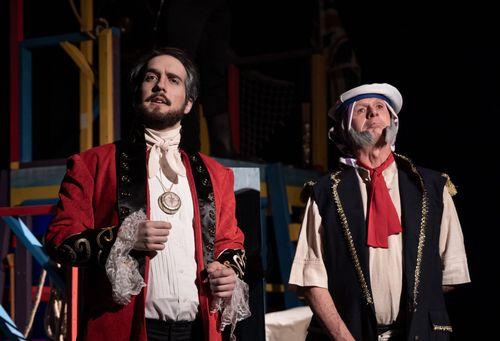
I'll start by saying Peter has been on my bucket list for a long time, since NAU did it my freshman year. I wasn't in it then, but I wish I was. The show definitely has faults - a lot of insensitive language (surprising given that it's fairly new) and silly, almost arbitrary staging at times. The music is questionable too, like the play wants to be a musical but also it doesn't. But despite its problems it's got a lot of pure comedy, especially from Black Stache, who very quickly became a bucket list role for me. The charm and confidence and anachronisms really drew me in, and I love those types of villain roles. I wouldn't even call Stache a villain, necessarily. But naturally when I found out MET was doing this show I knew I had to audition, and even though I don't normally do singing auditions, I did anyway. I got to callbacks - and it'd be a lie to say I wasn't bummed I didn't even get to read for Black Stache. I got cast as Lord Aster, which was loads of fun too, just in a different way. But because of that, I can't take this show off my bucket list yet...
I have a lot of mixed feelings about this production and I'm not sure how to feel. Overall I think I did well, and people told me I was awesome, but that the show itself wasn't. Some people I knew who saw it shamelessly said they hated it, and I think I can see why. Now I don't know all the details about the things I'm gonna describe here, and I like to give the benefit of the doubt, but what I'm gonna write here is just what I perceived being part of this process. And it's not good. I really don't want to write a post like this one, but I don't really have much positive to say about this production. ~~The people were great and I'd be happy to work with most if not all of them again, so no hard feelings and I hope they wouldn't be offended by what I have to say.~~ But I have some serious frustrations and this is my place to air them.
First, to get it out of the way: our director received a grant from ASU to do some research on us during this process. They also got together a couple other grad students to do their own sorts of projects and research on us. I assume that all of them were paid with the grant funding, though I guess I don't really know. We actors didn't see anything, which sounds about right for MET, but that's a separate gripe. I'd be curious to hear more about how MET and ASU wound up in this sort of partnership. From what I understand, the director's research is on directing actors with disabilities or with different access needs, which I think is great and not a problem. Fundamentally though, it feels to me like it was prioritized over actually crafting a show we could all be proud of. There were a couple other people brought in and I'll list them in the order I'll talk about them: a dialect coach, an intimacy coordinator, music director, choreographer, and a "dramaturg". I'll also talk a little bit about the acting/directing process I experienced. ~~All of these people were super nice, and I'm thankful for their time and effort anyway, and I hold nothing against them. I mean, the fact we even had this many people supporting us was awesome and unheard of in this sort of theatre circle and most of them I'd be happy to work with again.~~
Dialect: This guy was super nice, but he didn't help me at all. The time I finally approached him (after kinda expecting him to try to talk to me, which never happened) he told me I was perfect and right on the nose, to not change anything, and that I was one of the last people he was concerned about. That's nice, I suppose, but I don't think it was true. I don't remember how much of the show he actually watched, but I know there's parts I wasn't sure about where some dialect notes would've helped immediately. From other people who saw the show (and from my mom, who's from England, so I assume she's got a pretty good ear for it) I sounded "like an American trying to learn" and that it's passable, which is unacceptable to me. I want to do good work! I don't want to just be passing. What really would have helped me, and many others in the cast I'm sure, would've been dialect notes - he watches our rehearsal, then brings up specific words or sounds we should do differently. I've had dialect coaches do that before and it's incredible. Also having someone go over the rules of the dialect early on, and will stick to them and remind us of them, would've been nice. It feels to me like the best dialects in this show were brought in by the actors, not cultivated by the coach.
Intimacy: Disclaimer, I know that intimacy coordination is incredibly important. And we're here to make a safe space for everyone, and we're not gonna push people or assume they're okay with anything when they might not be. There's too many stories of people getting inappropriate, especially staging sex or other really intimate moments, and it takes a lot of trust and vulnerability to go there as an actor. And it really makes me happy to see intimacy coordination is catching on as an important part of theatre. I'm not saying we should do away with intimacy coordination, just that this is a prime example of it being done wrong. As for me, I hugged my daughter three times in the show, and each hug required an excruciatingly awkward "intimacy session" that made it worse than if we just hugged. Then we were obligated to do an intimacy call for the performances, which is just the same awkwardness. I can't imagine what it was like for the others in the show who do more intimate stuff. But there really isn't even that much in the first place. I don't think this was run in an effective way for the actors, because it just made me afraid to touch other people. It would've been nice if we spent a little time trying to open up, so that it felt like my daughter actually was my daughter - but instead it felt like I had to maintain an artificial distance and there's a line that I cannot cross. And this is for platonic things, like touching other people's shoulders, or maybe their arms or hands. Things that a dad would do for his daughter that he's sending off and won't see for a few weeks! Intimacy felt more like an obstacle (for all the wrong reasons) than a seamless and integrated part of our rehearsal process... plus it took a lot of time from some very crucial roles.
Music/Choreo: Well, we did our best! The songs and one dance number in the show were hard for us as a cast, and I think that's a direct consequence of casting a lot of non-singers and non-dancers (myself included, though I think I did decently). I wound up in this situation a lot where we'd sing the song, the music director would say it sounded good, and move on, but there was a tell that they didn't really believe it. We got a lot of positive affirmation, which is nice, but also if we're not good, let's make it good! I don't settle for subpar, but it feels like I had to. And I don't think these people had the means to teach us enough to get us to the point where we'd be good in the time frame we had, so it isn't their fault. They did their best too. It just always really really irks me to be told to be bad on purpose or to play up the campiness - "strong and wrong" isn't the worst thing on the planet, but our goal should've been to be strong and right! Though again, the music/dance in this play was so minimal I don't really think it matters in the grand scheme of things. But if that's the case, why'd we spend so much time in the callbacks singing? To wind up with people who don't really know how to sing? I mean, it's okay. I did my best.
Dramaturgy: Let's crack open the dictionary for a sec, shall we? "Dramaturge - n. 2. A person who is employed by a theatrical or opera company to assist in researching, selecting, adapting, or interpreting scripts or libretti." Super important position for a play, especially one that happens to be set in the British Empire in 1885. It can be a super powerful and rewarding position that can really enhance a play, and help inform actors of what, say, it would've been like to be a sailor in 1885. Or to be a minister to Queen Victoria, God Save Her. And to help consult on things like costumes or props, assist with directing and acting choices, what certain things mean, and things like that. But the person we had on the production team was NOT a dramaturg, at least not in the sense that I feel like that title should be used. The most dramaturgical thing they did was provide a pre-made packet of definitions for this play they found online that nobody actually read. Instead, we took a fun trip back to second grade and spent a rehearsal doing... I don't even know how to describe it. They gave us a handout with excerpts from the play, had us get into groups, read and talk about the themes of the play, and then set us loose to the winds with a bunch of paper and crayons and other craft supplies. I mean, I guess it was fun, but what was the point!? We spent a huge chunk of time on it, which proved to really kick us later. I think this person was doing research on creativity, and if that's the case, awesome. But why, why, why in the hell were they called the dramaturg? Was that just the excuse to get this person on the production so they could do their homework? I don't know, but from my point of view it was a serious misuse of the title, and a serious misuse of our very limited time. Plus it felt like we were being talked down to, like we were children, and the activity we did was pretty infantilizing.
Yeah... if you couldn't tell, I was quite frustrated. But all of this so far is fairly minor compared to my biggest complaint: we didn't get acting notes. Maybe in an email once in tech week, or something, but otherwise we just didn't get them. We never talked about character. We never discussed anything like objectives or actions, we were left to our own devices. By the end of the run I think I started discovering some pretty good stuff, but we should've found that in rehearsal. And maybe that would've been possible if our time was well-spent, but I'll get to that in a minute. Maybe our lack of notes comes from the director having done lots of work with children - where that type of cerebral acting stuff would go straight over their heads so you don't need to do it: just tell the gremlins where to stand and when. But no, we are all grown adults. It felt like either the director didn't have the capacity for the notes (in which case, why are you the director?) or they didn't really care that much (in which case, why are you the director!?). Or maybe there was something else going on I didn't know about, but I do know that not getting notes actively detracted from what this show could've been.
It also seriously hurt that we didn't do a first read-through. This is a theatre staple, and I can't say I've ever been on a production that hasn't had a first read-through. Go to find out, that skipping the read-through was part of the director's research... well, thanks for that. I kinda get it, a cold-read can be hard, but that's the point. It kinda felt incomplete without it. And it's not like we'd be expected to sing or anything either - but that's another thing we seriously should have done. We should have spent at least a rehearsal reading through and then listening through the sound effects from MTI, that way we wouldn't be three weeks in and be like "huh what's this sound effect?" - we could've built them into our production and our blocking and staging from day one, but because we just dove straight into it, we never got that chance to calibrate ourselves to this show or to the effects. The end result is that many sound effects felt weird and out of place to me as an actor - like do we say the line before the sound, during the sound, after the sound? What are all these things? I would've expected some guidance on these things early-on, but it never happened.
But this brings me to my biggest point: our time in rehearsal was critically mismanaged. I don't know how else to say it. We spent a long time working on things that really didn't matter: like excessive intimacy, lots of music calls, lots and lots and lots of time spent on fight choreography and lifts and such - which all went great, no complaints there, but it took so much time! We had only a month for this show - which is not unheard of in the industry, but here's the thing: this is a community theatre show, with community theatre actors. You can't have the same expectations of them as you would a group of professionals unless you're gonna pay them like professionals. If we had an extra week, or two, we would've been great. Or if we spent our time well. If that extra time can't be obtained, then maybe theatres like MET shouldn't be trying to produce shows like Peter. I felt the same way about Noises Off... and that's not even getting into how the theatre we're in is way too small for these big types of shows!
The other problem is that expectations were never set or enforced. Yeah, we had a nice laid-back process... until suddenly it was tech week and nobody knows their lines, then we bear the brunt of the stress at all once instead of gradually throughout a few weeks. Learning lines and attendance were two things that appeared incredibly problematic - it felt like a lot of cast members had a lot of conflicts, ~~which is totally okay,~~ but it also felt like there were days where people would be significantly late, and the production team just accepted it. Though, then again, what else are they gonna do? We never got an off-book date, or a last day to call line, so just like with acting we were on our own to learn and to keep ourselves on track to learn by opening night. Most of us got there, but we had to do a lot of covering the first few shows. This show is a very complicated one too, so a lot of people have a lot to remember. Again it just makes me sad, that it's not about trying to be good or even great - it was just about trying to not totally suck. Excuses became very accessible to us, and this isn't the first show I've worked on where I've felt like it was going too far. Like yeah, life's hard. We should care about and take care of one another, but we're also here to do some art. If you don't know if you have the time or energy to spare for a production, or you have too many conflicts, maybe you should think harder about it before going out for it.
And one last thing: audience mingling before the show. It'd be one thing if it was in-character. It was just as painful for the audience as it was for us. It also cracks me up that the director said they hate audience mingling too, then made us do it... was it a power move or something? It adds nothing and just makes us all antsy. I need that time before a show to prepare myself mentally for it, and so that's what I did. Most of the time the people who mingled were more mingling with one another... or worse, pulled out their phones waiting for something to happen. And the audiences were mostly very very small, which is another entire topic of discussion, but that also made it painful to watch.
It really sucks that I felt so frustrated about this. But this process was a mess, and it showed. I hate putting my name on work I'm not particularly proud of, and while I think I did good work, the show as a whole was weak. We did the best with what we had, and I don't think I could've or should've done anything differently. All this was out of my control, after all. But it does have me thinking - how hard can it be to get it right? And why does it feel like every theatre company around here continually gets it wrong, time and time again? It makes me want to form my own company and direct this show myself out of spite. So I think in the future my goal is going to be to surround myself with people who want to work at the same level as me - not making shows just for fun, but because they're important. I did have fun with this show, at the end of the day, and I think the pictures of it look awesome... And I met and got to know some pretty great people through it. But it really could've been so, so much more had the ball not been dropped.